

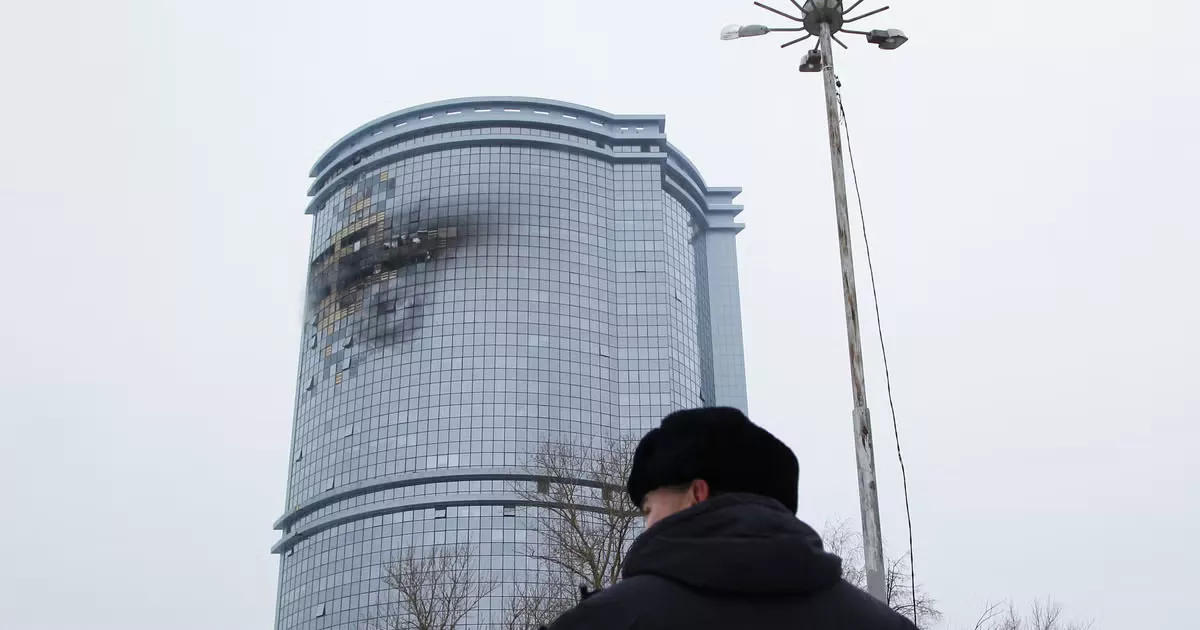
Russia has passed legislation allowing the country’s central bank and selected financial institutions to independently operate drone defence systems for the protection of their facilities, without the involvement of special security units.
The amendment became public after a document was published by Russia’s lower house of parliament on May 26, according to Russian media reports.
The law will permit selected members of staff "to jam or intercept drone control signals, as well as destroy unmanned aerial, surface and ground vehicles" if a threat is being identified.
Drone defence systems are expected to be deployed at the Bank of Russia, the country’s central bank, as well as at Russia’s largest lender, Sberbank, and the Russian Cash Collection Association.
The amendment also authorizes selected employees at those institutions to carry weapons and take action against identified threats.
The unusual legislation is being passed against the backdrop of ever-increasing attacks from Ukraine, particularly in 2026. While attacks did occur throughout all of the already four years since the beginning of the war, Ukrainian drone strikes inside Russia intensified sharply since January. Attacks from Kyiv even reportedly reached targets as far away as the Caspian Sea region and Western Siberia.
According to Anatoly Aksakov, the Head of the financial committee in the State Duma, the institutions themselves would bear the costs of the new drone defence systems.
Around the same time as news of the legislation emerged, Russian media reported on a suggestion made by Alexander Shokhin, who heads Russia’s most influential business lobby, who told President Vladimir Putin that private companies are prepared to finance the purchase of heavier weapons and electronic warfare systems to defend critical infrastructure from drone attacks.
International observers speculate that the move may reflect mounting pressure on Russia’s existing air-defence and drone-interception capabilities.
Until now, similar powers were reserved only for militarized structures such as Rosgvardiya, the National Guard.
The bill must still be approved by the upper chamber of parliament, the Federation Council, and signed by President Vladimir Putin before it can come into force.
The original draft of the legislation, first introduced in August 2024, applied only to the Bank of Russia and the state cash collection service Rosinkas.
The final version of the legislation significantly broadens its scope, extending it to Sberbank — Russia’s largest state-controlled bank — and the federal state enterprise Main Centre for Special Communications.
The authors of the bill said its purpose was to protect valuables in transit, precious metals and classified documents. The vast majority of attacks by Ukraine target energy infrastructure in an effort to undermine Russian revenues and weaken Moscow's war effort, with Russian banks not having been directly targeted so far.
By Nazrin Sadigova
Source: caliber.az






 scorpion.az