

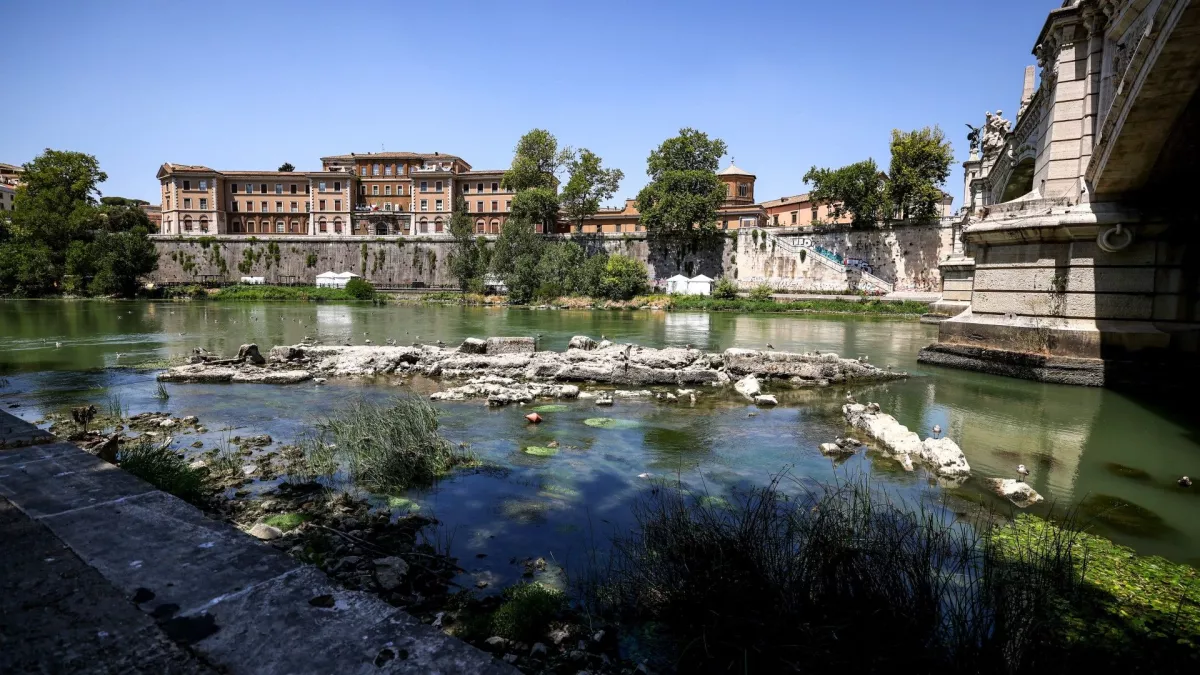
An ancient bridge believed to date back to the Roman imperial era has emerged from the Tiber River in Rome as drought and prolonged extreme heat drive water levels sharply lower.
The foundations of the structure have become visible near Castel Sant’Angelo, close to the Vatican, Caliber.Az reports, citing Russian media.
The bridge is thought to have been built during the imperial period and may date to the reign of Emperor Nero, who ruled from 54 to 68 AD. Researchers also believe it may have formed part of the ancient Triumphal Way, a route used since the Roman Republic for processions celebrating victorious military commanders.
The structure is believed to have linked Rome with the area that is now home to the Vatican City State.
Rome has endured more than three weeks of intense heat as an African high-pressure system continues to affect Italy. The current heatwave is the fourth to hit the country since mid-June, with the Italian capital repeatedly placed under the highest heat alert.
Italy’s Health Ministry has issued the highest-level heat warning for 20 cities, with the number potentially increasing by the weekend. Last week, all 27 cities covered by the country’s heat-alert system were placed under the highest warning level for the first time.
The prolonged heat and drought are also putting pressure on Italy’s agricultural sector, with falling river levels becoming a growing concern. The decline is particularly pronounced along the Po River in northern Italy.
Meanwhile, unusually high sea temperatures have been recorded along Italy’s coast, raising concerns over conditions that could contribute to severe thunderstorms and other extreme weather.
Experts say the current summer, already considered among the hottest in recent years, could eventually be viewed as “cool” by comparison with future seasons. Scientists warn that climate change is likely to bring increasingly hotter and longer periods of summer heat.
By Vafa Guliyeva
Source: caliber.az








 scorpion.az