

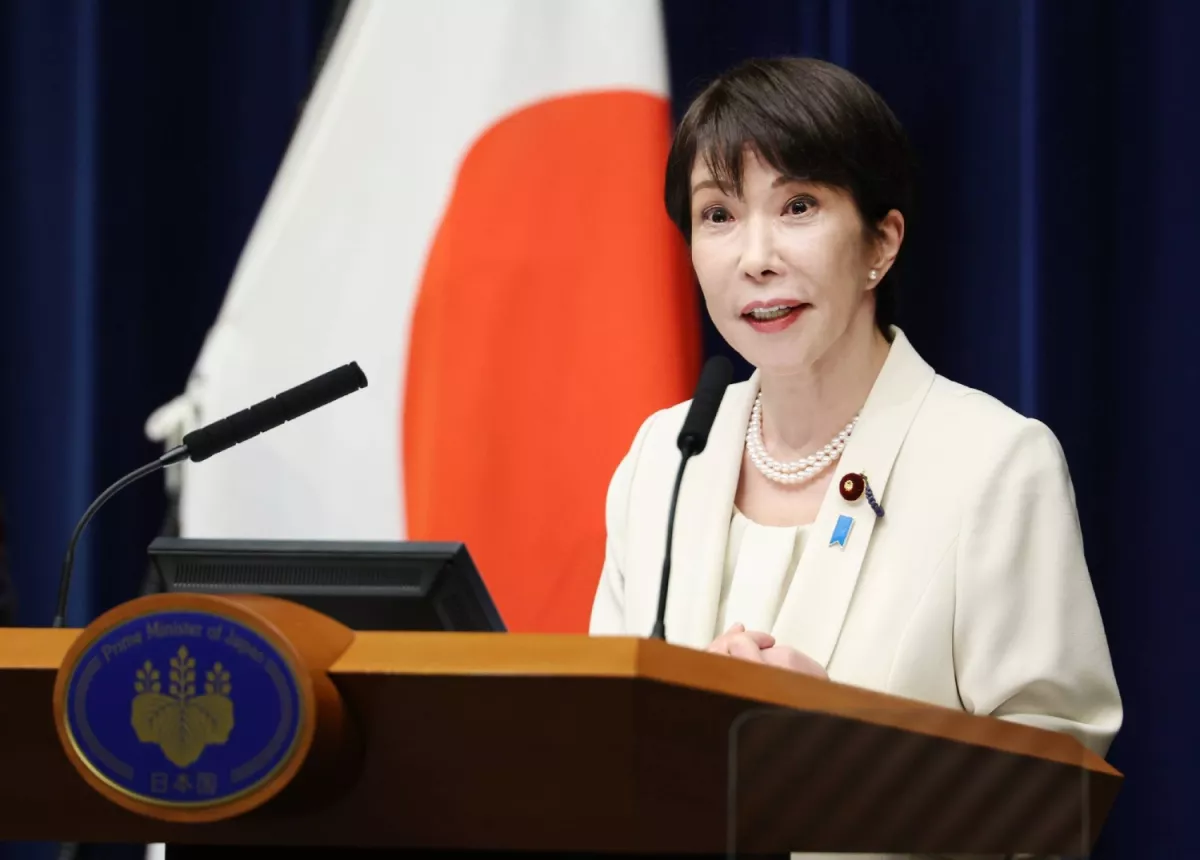
Japanese Prime Minister Sanae Takaichi has suffered the sharpest drop in her approval ratings since taking office last year, prompting renewed scrutiny of her leadership, The Japan Times reports.
The report said while the decline has sparked debate over whether it reflects the growing pains of a new administration or deeper structural problems, analysts suggest it stems from a combination of both.
Despite the setback, Takaichi's approval ratings remain relatively strong, ranging from the low 40s to the high 50s in recent polls—levels that continue to outperform those of her three immediate predecessors and are comparable to the popularity once enjoyed by former Prime Minister Shinzo Abe.
Liberal Democratic Party (LDP) Secretary-General Shunichi Suzuki downplayed concerns over the latest polling figures.
"Our stance remains unchanged: We will not get overly excited or discouraged by each individual increase in approval ratings, whether they rise or fall," Suzuki said, adding that while higher approval ratings help build momentum for government policies, the party would carefully analyse the results.
Takaichi's decline in support has coincided with persistent inflation, the absence of a clear economic recovery strategy, contentious legislation, coalition management challenges, and growing questions about her leadership style.
The government's handling of proposals to temporarily reduce the consumption tax on food has become a particular source of criticism. Disagreements within the LDP and among opposition parties delayed a decision, while senior LDP lawmaker Yuko Obuchi resigned from the party's tax panel in protest over the proposed policy. Although Takaichi has now instructed the party to pursue a reduction of the food consumption tax to 1%, critics argue the administration allowed the issue to linger for too long.
The government has also faced criticism over two controversial bills—one concerning imperial succession and another proposing Osaka as a secondary capital in the event of a national emergency. Opponents argued the legislation reflected political priorities rather than addressing voters' immediate concerns, including the rising cost of living.
At the same time, factional tensions within the ruling party have intensified. Former members of Shinzo Abe's political faction continue to compete for influence among conservative lawmakers, while former Prime Minister Shigeru Ishiba has held separate discussions with senior ministers on parliamentary affairs, highlighting divisions within the party.
Takaichi has responded by taking on an increasingly demanding workload. In a recent social media post, she revealed that she typically sleeps only "0–3 hours" a night while balancing the responsibilities of governing with household tasks.
The disclosure prompted concern from across the political spectrum. LDP Policy Research Council Chairperson Takayuki Kobayashi publicly urged the prime minister to prioritize rest, warning of the risks associated with overwork.
Political observers argue the episode also underscored a broader weakness within Takaichi's administration: the absence of senior aides capable of sharing the political and administrative burden.
While Takaichi has sought to emulate Shinzo Abe's leadership style through an active international agenda and ambitious policymaking, analysts note that she lacks key figures who helped sustain Abe's long tenure. Former Chief Cabinet Secretary Yoshihide Suga played a central role in coordinating ministries and resolving bureaucratic disputes, while longtime LDP Secretary-General Toshihiro Nikai was instrumental in managing internal party rivalries.
Those responsibilities now largely fall to Chief Cabinet Secretary Minoru Kihara and LDP Secretary-General Shunichi Suzuki, though observers say neither has yet demonstrated the same political influence as their predecessors.
Attention is now turning to Takaichi's upcoming Cabinet reshuffle, which is expected to serve as an opportunity to strengthen her administration, rebalance internal party dynamics, and reset the government's political agenda ahead of the next parliamentary session.
The decisions made during the recess are likely to shape both the composition of Takaichi's government and its ability to navigate mounting political and economic challenges in the months ahead.
By Bakhtiyar Abbasov
Source: caliber.az










 scorpion.az